


What is a meta description and how do you write one that actually gets clicks?
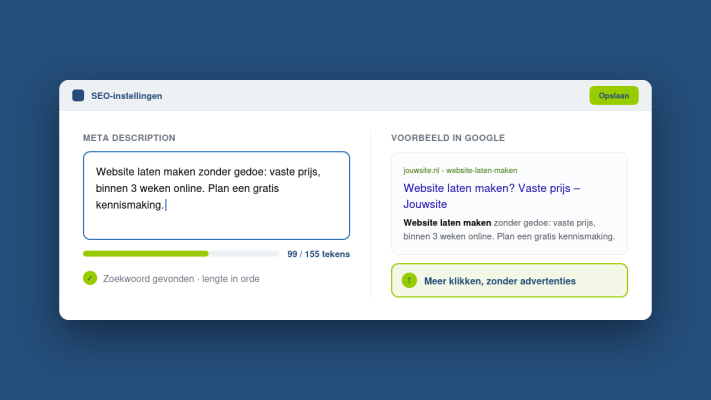
When you search on Google, you see a short piece of text below every page title. That is the meta description. It might seem like a small detail, but its impact is bigger than most people realize. A well-written meta description can convince someone to click on your result even if you are not sitting in the number one spot.
What exactly does a meta description do?
A meta description is an HTML meta tag placed in the source code of your page. Google does not use it as a direct ranking factor, but it does influence your click-through rate, or CTR. A higher CTR means more visitors to your website, and Google picks up on that indirectly. So it is absolutely worth putting some thought into.
It is also worth knowing that Google sometimes replaces your meta description with its own snippet if it thinks another piece of text from your page is more relevant to the search query. That is another good reason to write descriptions that closely match what people are actually searching for.
How long should a meta description be?
Google typically displays around 150 to 160 characters. Write more and it gets cut off with an ellipsis, which looks sloppy and cuts off your message. Keep it tight but make sure it says enough to convince someone to click.
How to write a meta description that actually gets clicks
There are a few things that separate a meta description people ignore from one that pulls them in.
- Include your keyword. Google bolds it when it matches the search query, which draws the eye immediately.
- Speak directly to the reader. Use words like "you" and describe what someone will actually find on the page.
- Give a reason to click. Will they get a step-by-step guide, a free tip, or a clear answer to their question? Say so.
- Add a gentle call to action. Something like "Read more", "See the full overview" or "Find out how it works" works well.
- Be honest. Only promise what the page actually delivers. Visitors who feel misled will leave quickly, and that hurts both your reputation and your stats.
Every page deserves its own meta description
A common mistake is using the same description across multiple pages, or not filling one in at all. Every page on your website has its own goal and its own audience. The meta description for your homepage is not the same as one for a blog post or a services page. Take the time to write them individually.
On your services page you want to convince people you are the right choice. On a blog post you want to spark curiosity. That calls for a different tone and a different approach.
Meta descriptions and SEO: the bigger picture
A meta description does not stand alone. It is part of a broader SEO strategy. If you are also working on things like structured data, internal linking and a solid sitemap, Google sees that you are taking your online presence seriously. All those small pieces add up.
Need help optimizing your website or want to know what could be improved technically? Feel free to get in touch. I am happy to think along with you.
Rather have it done than figure it out yourself?
I help businesses in Groningen, across the Netherlands and abroad with exactly this kind of question. Tell me briefly what you need and you will hear back within one working day.
Continue reading